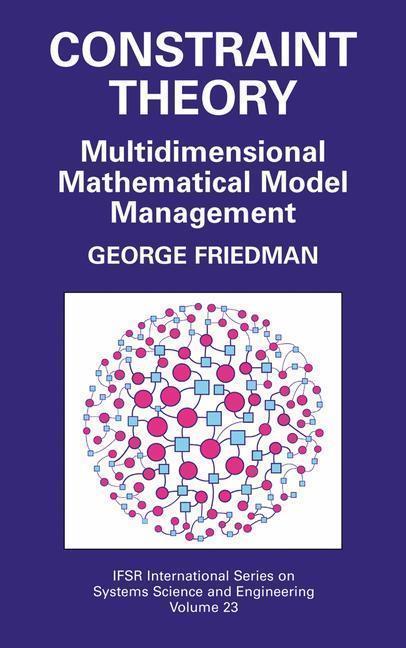
| Fronticepiece | 7 |
|---|
| Preface | 8 |
|---|
| Acknowledgments | 9 |
|---|
| Introduction | 10 |
|---|
| A Warmup Problem in Complexity | 14 |
|---|
| About the Author | 16 |
|---|
| Contents | 17 |
|---|
| Chapter 1 MOTIVATIONS | 20 |
|---|
| What is Constraint Theory and why is it important? | 20 |
| 1.1 TRENDS AND PROBLEMS IN SYSTEM TECHNOLOGIES | 20 |
| 1.2 AN EXAMPLE OF LOW DIMENSION | 23 |
| 1.3 THE MANAGER AND ANALYST CONTINUE THEIR DIALOGUE | 35 |
| 1.4 PRELIMINARY CONCLUSIONS | 39 |
| 1.5 A LITTLE WINDOW INTO FUTURE CHAPTERS | 41 |
| 1.6 PROBLEMS FOR THE CURIOUS READER | 42 |
| Chapter 2 THE FOUR-FOLD WAY | 43 |
|---|
| How to Perceive Complex Mathematical Models and Well-Posed Problems | 43 |
| 2.1 PROLOGUE: THE MANAGER AND ANALYST DISCUSS THE ORIGINS OF MULTIDIMENSIONAL MODELS AND WELL-POSEDNESS | 43 |
| 2.2 THE FIRST VIEW: SET THEORETIC | 46 |
| 2.3 THE SECOND VIEW: FAMILY OF SUBMODELS | 53 |
| 2.4 THE THIRD VIEW: THE BIPARTITE GRAPH | 56 |
| 2.5 THE FOURTH VIEW: THE CONSTRAINT MATRIX | 57 |
| 2.6 MODEL CONSISTENCY AND COMPUTATIONAL ALLOWABILITY | 58 |
| 2.7 THE MANAGER AND ANALYST CONTINUE THEIR DIALOGUE | 58 |
| 2.8 CHAPTER SUMMARY | 64 |
| 2.9 PROBLEMS FOR THE INTERESTED STUDENT | 65 |
| Chapter 3 GENERAL RESULTS | 67 |
|---|
| From Protomath to Math to Metamath | 67 |
| 3.1 LANGUAGE AND MATHEMATICS | 67 |
| 3.2 MOST GENERAL TRUSTWORTHY RESULTS | 69 |
| 3.3 CLASSES OF RELATIONS | 74 |
| 3.4 MANAGER AND ANALYST REVISITED | 77 |
| 3.5 CHAPTER SUMMARY | 78 |
| 3.6 PROBLEMS FOR THE GENERAL STUDENT | 78 |
| Chapter 4 REGULAR RELATIONS | 79 |
|---|
| Searching for the Kernels of Constraint | 79 |
| 4.1 COGNITIVE BARRIERS TO CIRCUITS | 79 |
| 4.2 NODE, KNOT AND BASIC NODAL SQUARE SANCTIFICATION | 81 |
| 4.3 USEFUL PROPERTIES OF BIPARTITE GRAPHS | 90 |
| 4.4 CORNERING THE CULPRIT KERNELS | TEN EASY PIECES |
| 4.5 CONTINUING THE PURSUIT INSIDE THE CIRCUIT CLUSTERS ( cc) | 105 |
| 4.6 LOCATING BNSs IN MINUTES, NOT UNIVERSE LIFETIMES | 108 |
| 4.7 COMPARISON OF COMPUTATIONAL COMPLEXITY | TRILLIONS AND TRILLIONS OF TIMES FASTER |
| 4.8 ZERO CONSTRAINT ALL ALONG THE COMPUTATIONAL PATH | 114 |
| 4.9 RECAPITULATION OF COMPUTATIONAL FLOW | 116 |
| 4.10 GENERAL PROCEDURE FOR DETERMINING CONSISTENCY AND ALLOWABILITY IN A MODEL OF REGULAR RELATIONS | 118 |
| 4.11 SUMMARY OF CHAPTER AND CONSTRAINT THEORY TOOLKIT | 122 |
| 4.12 QUERIES FOR THE REGULAR STUDENT | 127 |
| Chapter 5 DISCRETE AND INTERVAL RELATIONS | 129 |
|---|
| The Diminished Utility of Metamodels | 129 |
| 5.1 Metamodel Issues and Perspectives | 129 |
| 5.2 The General Taxonomy and Primary Property of Discrete Relations | 130 |
| 5.3 Boolean Relations | 130 |
| 5.4 Topological Implications | 136 |
| 5.5 Allowability of Discrete Computations | 138 |
| 5.6 Inequality Relations | 140 |
| 5.7 Summary | 143 |
| 5.8 PROBLEMS FOR THE DISCRETE STUDENT | 145 |
| Chapter 6 THE LOGICAL STRUCTURE OF CONSTRAINT THEORY | 146 |
|---|
| A Compact Summary | 146 |
| 6.1 Overview | 146 |
| 6.2 Postulates and Philosophical Assumptions | 146 |
| 6.3 Definitions | 147 |
| 6.4 Theorems | 147 |
| 6.5 Graphs of the Logical Structure of Constraint Theory | 148 |
| 6.6 Completeness | 148 |
| Chapter 7 EXAMPLES OF CONSTRAINT THEORY APPLIED TO REAL- WORLD PROBLEMS | 153 |
|---|
| 7.1 Apologies Not Required | 153 |
| 7.2 Cost as an independent variable (CAIV) | 153 |
| 7.3 The Kinematics of Free-Fall Weapons | 161 |
| 7.4 The Deflection of an Earth-Threatening Asteroid Employing Mass Drivers | 166 |
| Chapter 8 MANAGER AND ANALYST MEET AGAIN | 173 |
|---|
| Gists and Schizophrenia | 173 |
| Appendix A COMPUTATIONAL REQUEST DISAPPOINTMENTS | RESULTS OF THE USC ALLOWABILITY PROJECT |
|---|
| Appendix B GRAPH THEORY OVERVIEW | 186 |
|---|
| Why was the Bipartite Graph Chosen? | 186 |
| Appendix C THE LOGIC OF | 186 |
|---|
| Appendix C THE LOGIC OF | 186 |
|---|
| Appendix C THE LOGIC OF | 186 |
|---|
| Appendix C THE LOGIC OF | 186 |
|---|
| 190 | 186 |
|---|
| Appendix D VECTOR SPACES APPLIED TO GRAPH THEORY | 192 |
|---|
| References | 195 |
|---|
| Index | 197 |
|---|