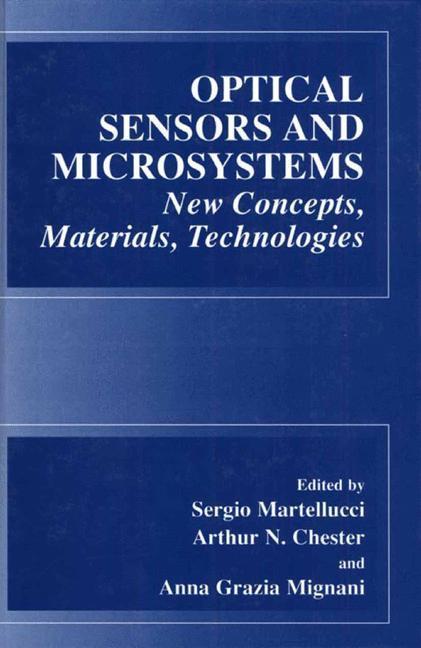
Optical Sensors and Microsystems
:
S. Martellucci, Arthur N. Chester, Anna Grazia Mignani (Eds.)
:
Optical Sensors and Microsystems
:
Kluwer Academic Publishers
:
9780306470998
:
1
:
CHF 159.80
:
:
Naturwissenschaft
:
English
:
312
:
DRM
:
PC/MAC/eReader/Tablet
:
PDF
Proceedings of the 22nd Course of the International School of Quantum Electronics, held 27 November-2 December 1997, in Erice, Italy.
In recent years, fiber optical sensors and optical microsystems have assumed a significant role in sensing and measurement of many kinds. These optical techniques are utilised in a wide range of fields, including biomedicine, environmental sensing, mechanical and industrial measurement, and art preservation. This volume, an up-to-date survey of optical sensors and optical microsystems, aims at combining a tutorial foundation with analysis of current research in this area, and an extensive coverage of both technology and applications.
COMPLEX ABCB-MATRICES: A GENERAL TOOL FOR ANALYZING ARBITRARY OPTICAL SYSTEMS
(p. 97-98)
1. INTRODUCTION
In this paper, we describe a novel formulation of light beam propagation through any complex optical system that can be described by an ABCD ray-transfer matrix.1,2 Within the framework of complex ABCD-optical systems, we then present novel speckle methods for analyzing linear and angular velocities and displacements. All methods rely on the dynamics of speckle patterns, produced by scattering of coherent light off solid surfaces undergoing angular and/or translational displacements.
Coherent light scattered off a rough surface produces a granular diffraction pattern some distance away from the object. This pattern is referred to as speckles,3 and originates from elementary interference of the waves emanating from many microscopic areas on the surface within the illuminated region. If the illuminated object is in motion, the resulting speckle pattern also evolves with time, i.e., a dynamical speckle pattern results. The target motion or displacement is usually determined by calculating the space- or time-lagged covariance of the detector currents before and after object displacement: and then determine the position where the peak of the covariance attains its maximum.
We first present the basic properties of the ABCD ray-matrix method,1,2 and summarize raymatrices for Simple optical elements,5 e.g., thin lenses, mirrors, and free-space propagation. Additionally, we present the ray-transfer matrix for a Gaussian shaped aperture.1,2 Thus, armed with matrix elements describing the most common elements in an optical system, the resulting ray-transfer matrix can be obtained for most systems encountered in practice. The resulting raytransfer matrix connects the input ray position and slope with the corresponding output parameters. Rather than dealing with rays, a Gaussian Green’s function has been developed,1,2 valid for arbitrary ABCD systems, to reveal the transition of the field in the input plane, through the ABCD-optical system, to the output plane.
Armed with the Green’s function that reveals the field in the output plane of an arbitrary ABCD-system, provided the field in the input plane is known, we then present a general equation, valid for arbitrary ABCD-optical systems, for the space-time lagged covariance of photocurrent: The position where the Gaussian-shaped covariance attains its maximum reveals information about target velocity or displacement. We discuss, how, in practice, the target velocity/ displacement is assessed. The theoretical results alluded to above are then applied to a series of novel optical sensor applications, all described by the ABCD kernel.
Two systems for measuring hear velocities, viz. the laser Doppler velocimeter6 and the laser time-of-flight velocimeter,7,8 are presented. A compact system for measuring linear surface velocities is presented, where all passive optical components are replaced with a single holographic optical element.9 Additionally, other novel schemes for further system miniaturization are presented.
We then present a new method for measurement of out-of-plane angular displacement in one or two dimensions.12,13 It is demonstrated that the angular displacement sensor is insensitive to both object shape and target distance, and any transverse or longitudinal movements of the target. It is further shown that the method has a resolution of 0.3 mdeg (5 µrad). A new method for measuring in-plane angular velocities or displacements are then presented.14 Here, we consider off-axis illumination, and it is shown that, for Fourier transform optical systems, in-plane rotation causes the speckles to translate in a direction perpendicular to the direction of surface motion, whereas for an imaging system, the translation is parallel to the direction of surface motion. Based on this, we discuss a novel method, which is independent of both the optical wavelength and the position of the laser spot on the object, for determining either the angular velocity or the corresponding in-plane displacement of the target object. The out-of-plane angular displacement sensor can be modified to measure the distribution of static torsion angles of targets undergoing twisting motion.15 Because the torsion angle sensor is independent of object shape, we measure the distribution of torsion angles in both uniform and non-uniform deformation zones.
Finally, we present a novel method for measuring out-of-plane angular velocities. Besides measuring angular velocities, the sensor can measure, simultaneously, torsional vibrations of the rotating shaft.
PREFACE
5
CONTENTS
7
TECHNOLOGY
10
ADVANCED OPTOELECTRONICS IN OPTICAL FIBRE SENSORS
11
1. INTRODUCTION
11
2. LASERS AND AMPLIFIERS
12
3. NON LINEAR OPTICS IN SENSOR SYSTEMS
14
4. STRANGE AND DIFFERENT PROPAGATION PHENOMENA
17
5. INTEGRATED OPTICS AND MICROMACHINING
20
6. OPTICAL SIGNAL DETECTION SYSTEMS
21
7. CONCLUSIONS
21
INTERFEROMETRIC DISTANCE SENSORS
23
1. INTRODUCTION
23
2. INTERFEROMETRIC DISTANCE MEASUREMENTS
23
2.1 Displacement measurements
24
3. DOUBLE WAVELENGTH INTERFEROMETRY
26
4. FREQUENCY-MODULATED INTERFEROMETRY
30
5. WHITE LIGHT INTERFEROMETRY
32
5.1 Optical sources for white light interferometry.
32
5.2 Mechanically scanned white light interferometer
33
5.3 Electronic-scanning white light interferometry
35
5.4 Dispersive white light interferometry
35
6. COMPARISON OF THE DIFFERENT TECHNIQUES
37
REFERENCES
38
OPTICAL TOMOGRAPHY: TECHNIQUES AND APPLICATIONS
40
1. INTRODUCTION
40
2. OPTICAL TOMOGRAPHY
42
3. TIME-RESOLVED IMAGING
42
4. FLUORESCENCE IMAGING
42
5. COHERENCE IMAGING
43
6. DIRECT TRANSILLUMINATION IMAGING
44
7. OPTICAL TOMOGRAPHY SCANNERS
44
8. CONCLUSIONS
45
REFERENCES
45
OPTICAL WAVEGUIDE REFRACTOMETERS
47
1. INTRODUCTION
47
2. REFRACTOMETERS FOR LIQUIDS: AN OVERVIEW
48
2.1. Classical refractometers
48
2.2. Interferometric refractometers
49
2.3. Non conventional refractometers
49
2.4. Optical fiber refractometers
50
2.5. Waveguide refractometers
51
3. CERENKOV REFRACTOMETRY
52
4. INVERSE USE OF CERENKOV REFRACTOMETRY
55
5. CONCLUSIONS
56
REFERENCES
57
CHARACTERIZATION OF AN OPTICAL FIBRE pH SENSOR WITH METHYL RED AS OPTICAL INDICATOR
58
1. INTRODUCTION
58
2. OPTICAL FIBRE PROBE
58
3. SPECTROPHOTOMETRIC ANALYSIS: PHOTODEGRADATION
59
4. OPTICAL FIBRE SENSOR
60
5. IONIC STRENGTH EFFECTS
62
CONCLUSIONS
64
REFERENCES
65
OPTICAL SENSORS AND MICROSYSTEMS USING LIQUID CRYSTALS
66
1. INTRODUCTION
66
2. LIQUID CRYSTALS OPTICAL AND ELECTRO-OPTICAL PROPERTIES
67
3. OPTICAL SENSORS UTILISING LIQUID CRYSTALS
73
4. OPTICAL MICROSYSTEMS UTILISING LIQUID CRYSTALS
76
5. OUR EXPERIMENTAL WORK
78
6. CONCLUSIONS
80
REFERENCES
81
INDIUM TIN OXIDE FILMS FOR OPTICAL SENSORS
83
1. INTRODUCTION
83
2. CHARACTERISTICS OF INDIUM TIN OXIDE
83
3. DEPOSITION PROCESS
84
4. PHOTOCONDUCTIVE EFFECT
84
5. PHYSICAL INTERPRETATION OF THE OBSERVED PHENOMENA
86
6. REVERSIBILITY OF THE VARIATIONS OF THE RESISTIVITY AND FACTORS THAT INFLUENCE THE SPEED OF RETURN TO THE INITIAL CONDITIONS
86
7. POSSIBLE APPLICATIONS OF THE PHOTOCONDUCTIVE EFFECT
88
8. CONCLUSIONS
89
REFERENCES
89
OPTOELECTRONIC NEURAL NETWORKS
90
1. INTRODUCTION
90
2. OPTOELECTRONIC NEURAL PROCESSING
90
3. OPTOELECTRONIC NEURAL NETWORKS
92
4. SPATIAL LIGHT MODULATORS AND VERTICAL CAVITY SURFACE EMITTING LASERS IN NEURAL SYSTEMS
94
5. OPTOELECTRONIC NEURAL SYSTEM FOR OPTICAL SENSOR SIGNAL PROCESSING
95
6. RESULTS OF EXPERIMENTS
97
7. CONCLUSIONS
99
REFERENCES
99
COMPLEX ABCB-MATRICES: A GENERAL TOOL FOR ANALYZING ARBITRARY OPTICAL SYSTEMS
100