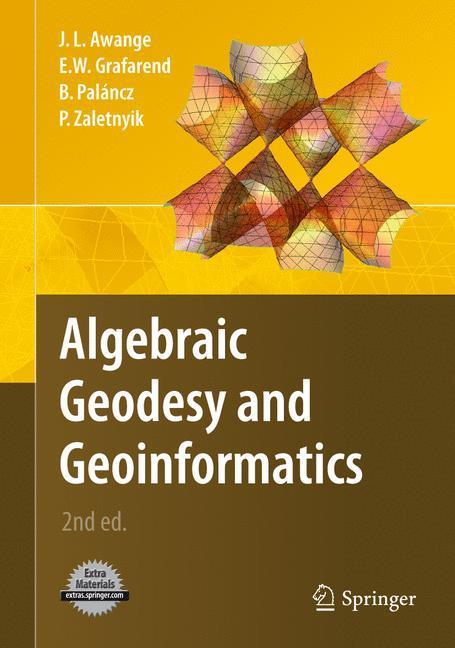
Algebraic Geodesy and Geoinformatics
:
Joseph Awange, Erik W. Grafarend, Béla Paláncz, Piroska Zaletnyik
:
Algebraic Geodesy and Geoinformatics
:
Springer-Verlag
:
9783642121241
:
2
:
CHF 199.40
:
:
Geografie
:
English
:
377
:
Wasserzeichen/DRM
:
PC/MAC/eReader/Tablet
:
PDF
While preparing and teaching 'Introduction to Geodesy I and II' to undergraduate students at Stuttgart University, we noticed a gap which motivated the writing of the present book: Almost every topic that we taught required some skills in algebra, and in particular, computer algebra! From positioning to transformation problems inherent in geodesy and geoinformatics, knowledge of algebra and application of computer algebra software were required. In preparing this book therefore, we have attempted to put together basic concepts of abstract algebra which underpin the techniques for solving algebraic problems. Algebraic computational algorithms useful for solving problems which require exact solutions to nonlinear systems of equations are presented and tested on various problems. Though the present book focuses mainly on the two ?elds, the concepts and techniques presented herein are nonetheless applicable to other ?elds where algebraic computational problems might be encountered. In Engineering for example, network densi?cation and robotics apply resection and intersection techniques which require algebraic solutions. Solution of nonlinear systems of equations is an indispensable task in almost all geosciences such as geodesy, geoinformatics, geophysics (just to mention but a few) as well as robotics. These equations which require exact solutions underpin the operations of ranging, resection, intersection and other techniques that are normally used. Examples of problems that require exact solutions include;• three-dimensional resection problem for determining positions and orientation of sensors, e. g. , camera, theodolites, robots, scanners etc.
"
1 Introduction
(p. 1-2)
1-1 Motivation
A potential answer to modern challenges faced by geodesists and geoinformatics (see, e.g., Sect. 1-3), lies in the application of algebraic computational techniques. The present book provides an in-depth look at algebraic computational methods and combines them with special local and global numerical methods like the Extended Newton-Raphson and the Homotopy continuation method to provide smooth and efficient solutions to real life-size problems often encountered in geodesy and geoinformatics, but which cannot be adequately solved by algebraic methods alone.
Algebra has been widely applied in fields such as robotics for kinematic modelling, in engineering for o set surface construction, in computer science for automated theorem proving, and in Computer Aided Design (CAD). The most wellknown application of algebra in geodesy could perhaps be the use of Legendre polynomials in spherical harmonic expansion studies. More recent applications of algebra in geodesy are shown in the works of Biagi and Sanso [77], Awange [14], Awange and Grafarend [41], and Lannes and Durand [259], the latter proposing a new approach to di erential GPS based on algebraic graph theory. The present book is divided into two parts.
Part I focuses on the algebraic and numerical methods and presents powerful tools for solving algebraic computational problems inherent in geodesy and geoinformatics. The algebraic methods are presented with numerous examples of their applicability in practice. Part I can therefore be skipped by readers with an advanced knowledge in algebraic methods, and who are more interested in the applications of the methods which are presented in part II.
1-2 Modern challenges
In daily geodetic and geoinformatic operations, nonlinear equations are encountered in many situations, thus necessitating the need for developing efficient and reliable computational tools. Advances in computer technology have also propelled the development of precise and accurate measuring devices capable of collecting large amount of data. Such advances and improvements have brought new challenges to practitioners in fields of geosciences and engineering, which include:
• Handling in an efficient and manageable way the nonlinear systems of equations that relate observations to unknowns. These nonlinear systems of equations whose exact (algebraic) solutions have mostly been difficult to solve, e.g., the transformation problem presented in Chap. 17 have been a thorn in the side of users. In cases where the number of observations n and the number of unknowns m are equal, i.e., n = m, the unknown parameters may be obtained by solving explicitly (in a closed form) nonlinear systems of equations."
Preface to the first edition
5
Preface to the second edition
9
Foreword
11
Contents
12
Introduction
18
Motivation
18
Modern challenges
18
Facing the challenges
19
Concluding remarks
22
Part I Algebraic symbolic and numeric methods
23
Basics of ring theory
24
Some applications to geodesy and geoinformatics
24
Numbers from operational perspective
24
Number rings
28
Concluding remarks
31
Basics of polynomial theory
32
Polynomial equations
32
Polynomial rings
33
Polynomial objects as rings
33
Operations ``addition'' and ``multiplication''
35
Factoring polynomials
36
Polynomial roots
36
Minimal polynomials
37
Univariate polynomials with real coefficients
38
Quadratic polynomials
38
Cubic polynomials
40
Quartic polynomials
41
Methods for investigating roots
42
Logarithmic and contour plots on complex plane
42
Isograph simulator
44
Application of inverse series
44
Computation of zeros of polynomial systems
45
Concluding remarks
47
Groebner basis
48
The origin
48
Basics of Groebner basis
49
Buchberger algorithm
55
Mathematica computation of Groebner basis
60
Maple computation of Groebner basis
61
Concluding remarks
62
Polynomial resultants
63
Resultants: An alternative to Groebner basis
63
Sylvester resultants
63
Multipolynomial resultants
65
F. Macaulay formulation:
66
B. Sturmfels' formulation
68
The Dixon resultant
69
Basic concepts
69
Formulation of the Dixon resultant
70
Dixon's generalization of the Cayley-Bézoutmethod
71
Improved Dixon resultant - Kapur-Saxena-Yang method
72
Heuristic methods to accelerate the Dixon resultant
73
Early discovery of factors: the EDF method
74
Concluding remarks
75
Linear homotpy
77
Introductory remarks
77
Background to homotopy
77
Definition and basic concepts
78
Solving nonlinear equations via homotopy
79
Tracing homotopy path as initial value problem
83
Types of lin