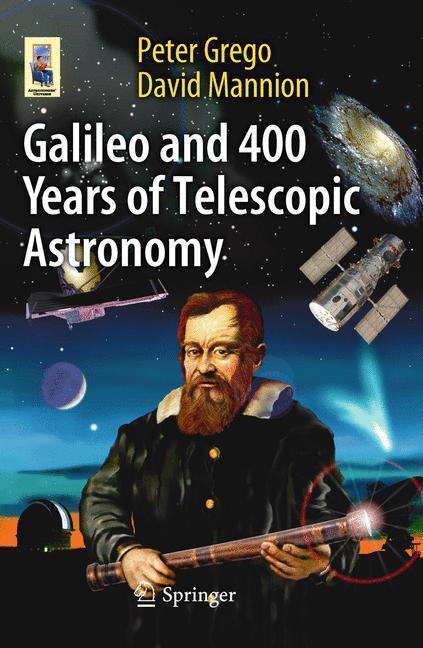
Galileo and 400 Years of Telescopic Astronomy
:
Peter Grego, David Mannion
:
Galileo and 400 Years of Telescopic Astronomy
:
Springer-Verlag
:
9781441955920
:
1
:
CHF 28.50
:
:
Astronomie
:
English
:
300
:
Wasserzeichen
:
PC/MAC/eReader/Tablet
:
PDF
In 1609 Galileo first used his telescope to kick start the science of observational astronomy - an event that proved to be of enormous historic, scientific, and cultural importance. Galileo and 400 Years of Telescopic Astronomy will feature the life and achievements of Galileo, around which has pivoted the story of four centuries of telescopic astronomy. The book will detail how astronomy has progressed through four centuries and contain glimpses of future space research and astronomy goals. Uniquely, interwoven with the text will be a range of practical projects for backyard astronomers in which to participate, projects that serve to illustrate many of Galileo's scientific discoveries.
Peter Grego is an astronomy writer and editor. A regular watcher of the night skies since 1976, he observes from his home in St Dennis, Cornwall, UK, with a variety of instruments. Grego's primary observing interests are the Moon's topography and the bright planets, but he likes to 'go deep' when there's no glare of the Moon to contend with. Grego has directed the Lunar Section of Britain's Society for Popular Astronomy (SPA) since 1984 and is the Assistant Director of the Lunar Section of the British Astronomical Association (BAA). He edits and produces four astronomy publications - Luna (journal of the SPA Lunar Section), The New Moon (journal of the BAA Lunar Section), the SPA News Circulars, and Popular Astronomy magazine. He is also layout editor for the Newsletter of the Society for the History of Astronomy. Grego is the author of numerous astronomy books, including: Collision: Earth! (Cassell, 1998), Moon Observer's Guide (Philip's/Firefly, 2004), The Moon and How to Observe It (Springer, 2005), Need to Know? Stargazing (Collins, 2005), Need to Know? Universe (Collins, 2006), Solar System Observer's Guide (Philip's/Firefly, 2005), Venus and Mercury and How to Observe Them (Springer, 2008); Astronomical Cybersketching (Springer, 2009); The Great Big Book of Space (QED, 2010), and others. He has given many talks to astronomical societies around the UK and has been featured on a number of radio and television broadcasts. Grego maintains his own website at www.lunarobservers.com (which occasionally features live webcasts of the Moon and planets and other astronomical phenomena) and is webmaster for the BAA Lunar Section at www.baalunarsection.org.uk . He is a member of ALPO, SPA, SHA, and BAA and is a Fellow of the Royal Astronomical Society. David Mannion has three degrees in astronomy and has worked as a teacher for 23 years in schools and colleges in the UK, Austria, and Turkey, and has also tutored for the Open University in Physics and Astronomy. He is a Fellow of the Royal Astronomical Society, having been elected in 1984 and was a member of its Education Committee 2005 - 2010. Dr. Mannion has given lectures on astronomy since 1980, run numerous School Astronomy Clubs, and was vice president and a founder member of the Association for Astronomy Education. His other burning interest is weightlifting and he has participated in the last 6 years of the British Masters Weightlifting Competition. He won in his age group and weight category in 2007 and 2010! He wants to continue watching the stars and lifting weights for as long as he possibly can!
Galileo and 400 Yearsof Telescopic Astronomy
3
Foreword
5
Preface
7
Contents
9
1. Eyes on the Skies
10
Pre-Telescopic Astronomical Ideas, Inventions and Discoveries
11
Eastern Skies Under Scrutiny
15
Ancient Greek Philosophy
17
On the Ball
18
Aristarchus Takes Center Stage
19
Eratosthenes Takes Measures
19
Project #1: Measure the Earth s Circumference
20
Hipparchus Heavens
22
Loopy but Long-Lasting
26
Ancient Astronomical Equipment
27
Project #2: Make Your Own Naked-Eye Cross-Staff
30
The Antikythera Mechanism
32
Dogma Defied
35
Sparking a Celestial Revolution
36
Hard-Nosed Inquiries
37
Planetary Law-Maker
44
2. Galileo Magnifico
48
Galileo the Scientist
48
Getting the Ball Rolling
50
Project #3: Measuring Acceleration Due to Gravity
51
Galileo s Telescope
52
Project #4: Make Your Own Galilean Telescope
54
The Starry Messenger
58
The Moon
60
Harriot s Lunar First
61
Galileo s Moon and Earthshine
64
A New World
65
Project #5: Observing Opportunity View Galileo s Moon
67
The Mountains of the Moon
71
Project #6: Observe and Draw the Moon s Craters
72
The Sun
75
Project #7: Observe the Sun
80
Planets
84
Venus s Phases
84
Project #8: Observe Venus s Phases
88
Jupiter
88
Project #9: Observe the Galilean Moons
88
Dynamic Gas Giant
90
An Amazing Conjunction
92
Project #10: Observing Opportunity: Significant Conjunctions 2011 2021
93
Saturn
94
Project #11: Following Saturn
96
Stars
97
Project #12: Pleiades Perception
99
The Final Years
99
3. Newton s Universe
103
Exciting Times
104
Newton s Annus Mirabilis
106
The Principia
109
Newton s Three Laws of Motion
109
Newton s Law of Universal Gravitation
111
Conservation Law of Momentum and Angular Momentum
112
Gravitational Slingshot
112
Newton s Cradle
113
Escape Velocity
114
Opticks
115
Packets of Light
117
Inflexions and Rings
118
A New Kind of Telescope
120
Newton in a Nutshell
122
4. Surveying the Solar