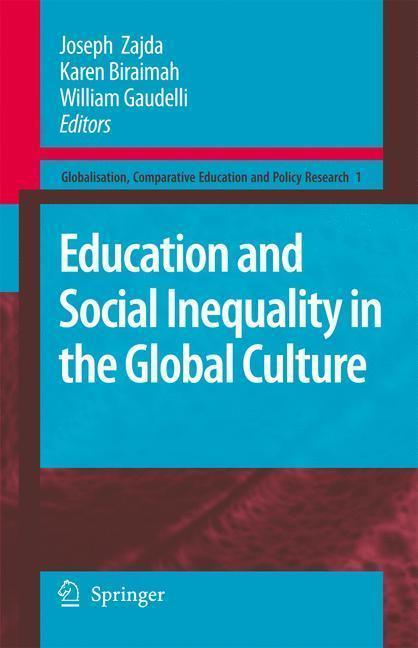
: Joseph Zajda, Karen Biraimah, William Gaudelli
: Education and Social Inequality in the Global Culture
: Springer-Verlag
: 9781402069277
: 1
: CHF 85.90
:
: Bildungswesen
: English
: 233
: Wasserzeichen/DRM
: PC/MAC/eReader/Tablet
: PDF

This book critically examines the overall interplay between globalisation, social inequality and education. It explores conceptual frameworks and methodological approaches applicable in the research covering the State, globalisation, social stratification and education. The book, constructed against this pervasive anti-dialogical backdrop, aims to widen, deepen, and in some cases open, discourse related to globalisation, and new dimensions of social inequality in the global culture.

"Chapter 3

Religion, International Aid, and Used Clothing: Globalization and Mayan Literacy Revival in Guatemala
(p. 41-42)

Mary Holbrock

1 Introduction

The indigenous languages and cultures of Guatemala are currently experiencing revitalization efforts as is the case with many of the indigenous languages of the Americas and other parts of the world. This study examines Mayan literacy revival in Guatemala, broadly defined to include a range of cultural literacy practices, and the involvement of globalization in that phenomenon. Globalization is most commonly thought of as the imposition of so-called""Northern"" or""First World"" culture and economics at the expense of the""South"" or""Third World"".

But in the case of Mayan literacy revival, the direction of the movement of global forces is more complex. This chapter suggests that there are three ways in which globalization is involved in Mayan literacy revival. Two effects are related to forces coming in to affect literacy. Some of these, such as religion, mass media, and used consumer goods, take on culture-suppressing forms, while others, such as the women s movement and the work of international aid organizations, take on culture-sustaining forms. Yet Mayan literacy in the form of alphabetic print, glyphs, and traditional clothing and folklore is also moving from inside Guatemala to the outside world by way of migration, the Internet, and tourism.

Globalization is commonly thought of as the export of Western culture to the rest of the world. A definition given in a 1995 lecture by Martin Khor states this concept nicely:""Globalisation is what we in the Third World have for several centuries called colonization or imperialism"" (as cited in Baylis&, Smith, 1995, p. 15). Although there is certainly truth to this definition, globalization is more complex. A definition by Giddens (1990) which defines globalization as""the intensification of world wide social relations which link distant localities in such a way that local happenings are shaped by events occurring many miles away and vice versa"" (p. 64, emphasis added) captures the true complexity of this phenomenon.

It is the""vice versa"" part of this definition which challenges the traditional point of view. What is interesting about the Mayan literacy revival situation is that both""import"" and""export"" aspects of globalization are present. The Mayan language literacy revival movement is shaped by events occurring far away, but, in turn, it is shaping, or at least its products are appearing, in distant locales. Outsider influence is present in the movement, but Mayan literacy is also appearing abroad.

This chapter discusses aspects of globalization involved in a Mayan literacy revival movement which is taking place in Guatemala. It is based on qualitative research conducted mainly during 2001. Research methods followed an instrumental case study model in which Mayan literacy revival was investigated by focusing largely on two research sites, Santa Eulalia, Huehuetenango, and San Pedro la Laguna, Sololá. The Mayan languages spoken in these two villages are Q anjob al and Tz utujiil, respectively. Data-gathering methods included qualitative interviews with 60 participants, observations of primary school and adult literacy classes, and homestays with Mayan families."
Zajda_FM.pdf2
Zajda_Ch01.pdf28
Zajda_Ch02.pdf44
Zajda_Ch03.pdf67
Zajda_Ch04.pdf83
Zajda_Ch05.pdf97
Zajda_Ch06.pdf110
Zajda_Ch07.pdf128
Zajda_Ch08.pdf147
Zajda_Ch09.pdf164
Zajda_Ch10.pdf178
Zajda_Ch11.pdf204
Zajda_Index.pdf226
Zajda_BM.pdf233