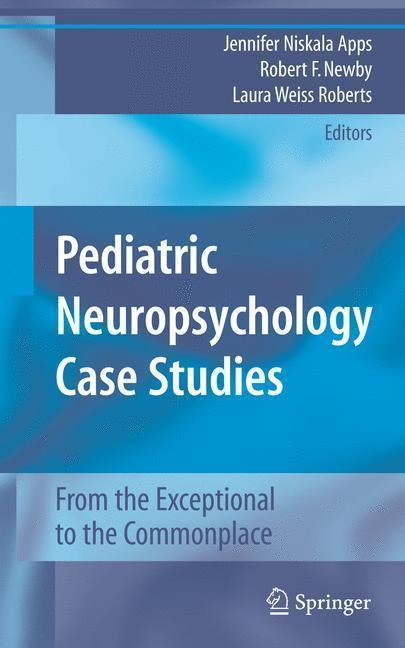
In the recent literature, the most influential case study books in neuropsychology are in the adult realm. Pediatric neuropsychology is a rapidly developing field with increasingly greater influence in the assessment, diagnosis, early identification, and treatment of childhood illnesses. This book will provide the first centralized, comprehensive resource for case studies in pediatric neuropsychology. Not only will this supply a valuable compilation for the growing numbers of professionals in this field, but will also serve as an innovative and appealing resource for therapists, teachers, and others interested in child development. This book will be structured in such a way that readers can easily access individual cases of interest, as well as related areas of dysfunction. Section breakdowns will be provided in order to highlight the combined focus of case presentations in acquired neuropsychological dysfunction as well as developmental disorders. Each section will begin with an introductory chapter, highlighting the salient feature of the concept and providing brief, up to date reviews of the current research and theories. Within each global section, individual case studies will serve as stand-alone chapters. Contributing authors will be provided extensive guidance and coaching with regards to the standard format and information to be included in each chapter. The first section of this book will present cases involving neurological disorders. The intention of this section is to provide not only 'classic' examples of neurological dysfunction in children, but also to provide interesting cases of unique or remarkable presentations. The second section will present an accumulation of cases representing both common and progressive conceptualizations of developmental disabilities. Section three has been designed to highlight cases which often present complex issues to neuropsychologists. The case examples in this section will highlight the use of alternative treatments, pathologies that are often a source of inquiry, and situations that lack the more rigorous scientific data often utilized in other diagnostic procedures. Additionally, this section may include chapters on common differential diagnosis dilemmas in clinical practice. Often multifaceted and even contradictory evidence can arise during evaluations, resulting in complex or problematic situations for the clinician. Such examples are difficult, by their nature, to forecast, but rather would be added during the book's development, as they occur.
Jennifer A. N. Apps, Ph.D., is Assistant Professor, pediatric neuropsychologist, and Assistant Director for Research in the Division of Child and Adolescent Psychiatry and Behavioral Medicine at the Medical College of Wisconsin. Dr. Apps specializes in the evaluation and treatment of children with comorbid emotional and neurological disorders. She received her PhD from the University of Texas Southwestern Medical Center at Dallas and completed post-doctoral training at Children's Hospital of Dallas. Her primary research interests are in the area of pediatric Bipolar Disorder. She has published several articles in professional journals and frequently gives both professional and educational lectures on pediatric mental health issues. Robert F. Newby, Ph.D. is Associate Professor, pediatric Neuropsychologist, and Co-Director of the Neuropsychology Division of the Department of Neurology at the Medical College of Wisconsin. He specializes in the evaluation and treatment of children with neurological and learning disorders. He received his Ph.D. from the University of Kansas and completed an internship and postdoctoral fellowship at the University of Wisconsin Health Sciences Center in Madison. He has a Diplomate in Clinical Neuropsychology, awarded by the American Board of Professional Psychology and the American Board of Clinical Neuropsychology. Dr. Newby's primary research interests have been in dyslexia, reading disabilities and Attention Deficit Hyperactivity Disorder. He has published articles in professional journals, book chapters, and a book for parents; he has received research grants from several foundations. Dr. Newby is on the Professional Advisory Board of the Wisconsin Chapter of the Learning Disabilities Association. Lau a Weiss Roberts, M.D., M.A. is Chairman and Charles E. Kubly Professor in the Department of Psychiatry and Behavioral Medicine at the Medical College of Wisconsin. Dr. Roberts is a career scientist funded by the National Institutes of Health, and a nationally recognized scholar and leader in ethics, psychiatry, medicine, and medical education. Before coming to Milwaukee, Dr. Roberts served as a Professor of Psychiatry, Vice Chair for the Department of Psychiatry and the Director of the Institute for Ethics at the University of New Mexico, where she completed her psychiatry training and then remained on faculty for 8 years. She is the Editor-in-Chief for the journalAcademic Psychiatry and serves as an editorial board member and peer reviewer for many scientific journals. Dr. Roberts has received numerous awards for her scholarship, leadership, and teaching, and has been an invited speaker for over 100 presentations, workshops and seminars. A dedicated writer, she has written extensively on topics including clinical and research ethics, informed consent, clinical medicine, educational scholarship, end-of-life care, physician and medical student health care. |